


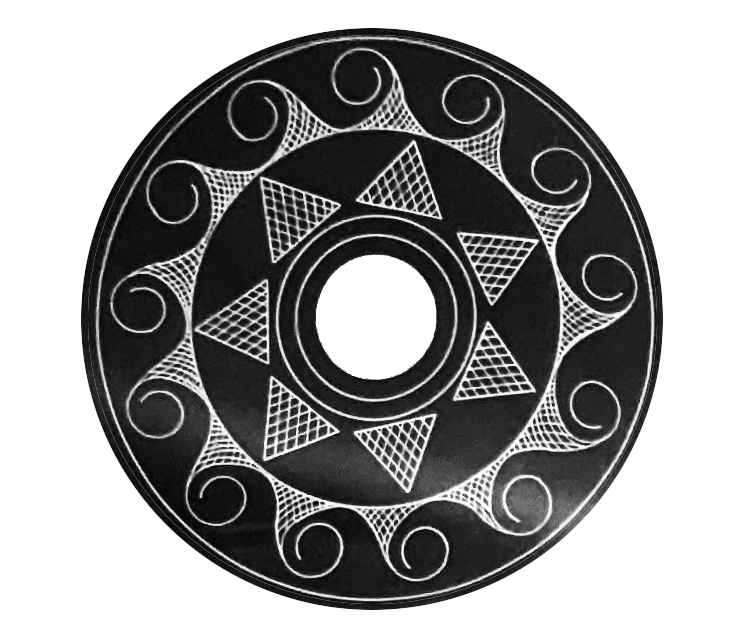
History of the Muiscas
The Muisca, one of the four advanced civilizations in the Americas before the Spanish conquest, resided along the eastern ranges of the Andes Mountains in the heart of modern-day Colombia. Much like the Aztec and Maya civilizations in the north and the Incas in the south, the Muisca occupied the highlands with an abundance of natural resources where they flourished. However, the Muisca differed in many ways from their neighbors.
The Muisca were organized loosely into a confederation by a set of rulers called caciques. The most important cacique was the iraca who lived in the sacred “City of the Sun” known as Sugamuxi (present-day Sogamoso). Sugamuxi was its religious center - much like the Rome or Mecca of the Muisca civilization. They constructed modest, circular houses made of wood and clay called bohíos instead of stone architecture like other groups. Throughout the territories of the Muisca Confederation, there were numerous temples - most notably the Temple of the Sun, built to honor the Sun god Sué.

The reign of the Muisca lasted until 1537 when Spanish conquistadors led by Gonzalo Jiménez de Quesada arrived in search of the legendary El Dorado. The Temple of the Sun was burned by torches, and many of other sites that once had Muisca temples were replaced by Catholic churches. Some historians assert that in only two generations (approximately 40 years), the Muisca language and religion had practically disappeared. Unfortunately, there are very few scholarly works about the Muisca, and an overall lack of a global consensus. Many of the remaining documentation derives with a western mentality, often with prejudices of Amerindians made by their Spanish colonizers. In recent years, there have been efforts in revitalizing and reconstructing the Muisca ethnic culture. In 2002, the National Indigenous Organization of Colombia helped create the Great Council of the Muisca People (Cabildo Mayor del Pueblo Muisca) with the goal of linguistic and cultural recovery.

As many of the existing structures were erased from existence, their art is the most important remnant of their culture. The most famous example is the Muisca raft, a votive offering piece made of gold currently displayed in the Museo del Oro (Gold Museum) in Bogotá. The Muisca raft commemorates a ritual in which a new cacique would cover themselves in gold dust and aboard a raft, floating to the center of the lake and tossing gold offerings to appease the gods. Gold pieces from the Muisca were not used as clothing or jewelry, but rather exclusively for symbolic purposes known as tunjos. Many elements of Muisca paintings, engravings, ceramics, and jewelry are related to the concept of life, human fertility, and the fertility of the earth. The Muisca interpreted the world with such meaning and value - their religion and mythology were closely connected to their environment.

Lake Tota
Drawing admiration for its crystalline waters, Lake Tota is the largest lake in Colombia. The name Tota comes from the Chibcha language of the Muisca and refers to “Astronomic Observatory”. The Muisca had many charming myths about this lake, most notably the monster of Lake Tota. Today, the main land use activity is the cultivation of onions, with 90% of the Colombian onion production concentrated here. Lake Tota is also an important breeding ground for several threatened and endangered bird species. The water flowing into the lake originates primarily from the surrounding paramo ecosystem, a unique type of biome only found in six countries in the world.

-
Sogamoso, or the City of the Sun, is the capital of Sugamuxi with a population of more than 150,000 people. It is also referred as the "Rome" of the Muisca civilization, and is home to the Temple of the Sun.
-
-
A charming town in spiritual lands, Monguí is considered one of the most beautiful pueblos in Boyaca. With it’s old world architecture, Mongui has a reputation for their handmade traditional soccer balls and proximity to the páramos.
-
Tota is a tiny town with an ancient, well-kept rural culture. It shares boundaries with Lake Tota and is special for its unique Andean scenery and Playa Blanca, a fresh water white sand beach.
-
-
Also known as the "green nest," Iza is one of the best kept and most graceful towns in Sugamuxi. Iza is the ideal destination for relaxation, found in its thermal hot springs, and for peaceful meditation.
-
Easily one of the most lovely and well kept towns in Sugamuxi, Tibasosa is a must visit with mouth-watering cuisine and breathless views of its stunning surroundings.
-
With ecosystems like the páramos of Colombia and high-Andean forests, it is always possible to find colorful, adventurous areas to enjoy in rural Pesca.
-
An absolute invitation to a dream, Firavitoba (also known as Fira) is an indigenous town surrounded by exquisite scenery views of valleys and mountains.
-
A peaceful village of land cultivation, Mongua offers artistic stone carvings, the Black Lagoon nature reserve, and the spectacular El Morro de Use, a majestic overlook to all of eastern Colombia.
-
The alluring town of Tópaga is a gracious place to find a park of clever grass sculptures, a truly original cathedral decorated in craft gold, and innovative coal art.
-
Set above canyons and racing rivers, Gámeza is home to ancient petroglyphs. It has embraced this cultural aspect with an unforgettable Piedra Pintada, natural painted stone rock zoo.
-